When counties across western North Carolina began accepting FEMA Hazard Mitigation properties into the program, many of them started to wonder about the liability associated with the long-term management of what would become public property. Following Helene, many of the buyout properties had landslides on them or were at risk of having a landslide affect them in the future. Of course, landslides are not the only hazard that may impact properties in a buyout program, but this realization lead the NC General Assembly to provide some added protection for local governments. Read more about the changes in this new blog post by Taylor Morris and Rebecca Fisher-Gabbard.
Author Archives: Amanda Nicole Stratton
New Blog Post: Understanding and Using the LGC’s Financial Performance Indicators
Check out Kara Millonzi’s new blog post to better understand the Financial Performance Indicators that the LGC uses to asses a local government’s financial position.
New Disclosure Requirements for Development-Related Fees Including Chapter 160D Fees, Local Act Impact Fees, and System Development Fees
Read this blog post by Kara Millonzi to better understand the new disclosure requirements around development-related fees. As outlined in the post, “The new law adds three principal requirements: 1. Publication of fee information, including how the fees are calculated; 2. Annual reporting to the LGC; and 3. Project-specific fee estimates and final fee statements.” This law came into effect on August 11, 2026, and local governments should immediately evaluate their fee schedules and update accordingly.
This obviously affects development in a broader sense than just recovery-related development, but with many new houses and buildings being constructed across the region, it is important to consider these new requirements as applications are submitted.
Budget Bill Eliminates HUB Office and Repeals Statutory HUB Language
“The 2026 Appropriations Act, which became law as Session Law 2026-41 on July 7, 2026, eliminated the Office of Historically Underutilized Businesses (“the HUB Office”), repealed HUB-related statutes, and struck references to minority participation in public contracts throughout the North Carolina General Statutes. Additionally, the bill transferred administration of the North Carolina Small Business Enterprise (NCSBE) Program to the Division of Purchase & Contract within the Department of Administration.”
Read more about these changes in the Coates’ Canons blog post by Crista Cuccaro here: https://canons.sog.unc.edu/blog/2026/07/08/budget-bill-eliminates-hub-office-and-repeals-statutory-hub-language/
Rising Above Helene Documentary
The North Carolina Association of County Commissioners and 100 Strong Productions created a documentary about what happened in the aftermath of Hurricane Helene in WNC. You can now “what the story of a region the refused to give up.”
Permit Free Firewood Collection- Pisgah National Forest
As concerns around wildfire remain across the region, the National Forest Service has issued the following information about collection of firewood for personal use:
“Hurricane Helene left a significant amount of woody debris across much of Western North Carolina, leaving higher-than-usual levels of fuels on the ground. This creates a heightened risk of wildfire. The public can help mitigate this risk by collecting downed wood to warm their homes during the winter season.
Firewood can be gathered from along all open roads on any re-opened portion of the Pisgah National Forest. Portions of the Pisgah still remain closed because of impacts from the storm, including areas on the Appalachian Ranger and Grandfather Ranger districts.
Please contact the local ranger district for more information on where firewood can be gathered.
- Appalachian Ranger District, spanning Avery, Buncombe, Haywood, Madison, Mitchell and Yancey counties: (828) 689-9694
- Grandfather Ranger District, spanning Avery, Burke, Caldwell, McDowell and Watauga counties: (828) 652-2144
- Pisgah Ranger District, spanning Buncombe, Haywood and Transylvania counties: (828) 877-3265″
Click here for more information: https://www.fs.usda.gov/r08/northcarolina/alerts/permit-free-firewood-collection-pisgah-national-forest
Index of Select Emergency Management Resources for North Carolina Local Governments
This index provides a select list of resources for North Carolina local governments addressing emergency management issues. It is intended as a starting point for officials and staff seeking practical guidance across a range of government operations and service areas. Resources are organized by topic area and by type (including trainings, publications, laws, and contacts) to help users quickly find relevant information and assistance for emergency management planning, response, recovery, and related efforts. Because emergencies can limit access to outside resources and create significant stress, the index emphasizes the importance of becoming familiar with key local resources and personnel before these situations occur.
Users are encouraged to print and share the PDF version of this index with colleagues, local government departments, and community partners so that critical information remains accessible when it is most needed.
https://ncrecoveryportal.com/wp-content/uploads/2026/06/EMR_Index_2026.pdf
FEMA Review Council Final Report
On May 7, 2026, the President’s Council to Assess the Federal Emergency Management Agency released its final report. You can view the full report here: https://ncrecoveryportal.com/other-resources/fema-review-council-final-report/.
Water & Wastewater Round Table: Exploring Regional Partnerships, from Joint Purchasing to Shared Staff and Beyond
Regionalization isn’t just about mergers and consolidations. It’s shared equipment and personnel, emergency communication plans, joint purchasing agreements, bulk service contracts, and so much more — and chances are, your utility is already doing some version of it.
Join the UNC School of Government Environmental Finance Center for an open, practitioner-focused discussion where local government water and wastewater utilities can share what they’re already doing, explore what they’re considering, and get honest feedback from peers facing the same challenges. The SOG EFC will open with a brief presentation drawing on findings from its recent legislatively directed study on regional partnerships, framing the wide landscape of collaboration options available to utilities.
But the heart of this session is your experience. We want to hear what’s working, what’s stalled, and what questions you haven’t been able to answer yet. We’ll also use this time to begin building a network of utilities committed to learning from one another on this topic. The SOG EFC will be gathering input on what resources, tools, or ongoing support would be most useful as you navigate partnership opportunities.
Whether you’re deep into a regional arrangement or just starting to think about it, come ready to talk, share ideas, and ask questions.
Who Should Attend? Utility staff, managers, finance staff, and elected officials who want to share their experiences with others and learn more about regional partnerships
When? May 21, from 9am-11am on Zoom
How? Register now at https://unc.zoom.us/meeting/register/nQvsEkZOR-OPMCvUSCMMgA
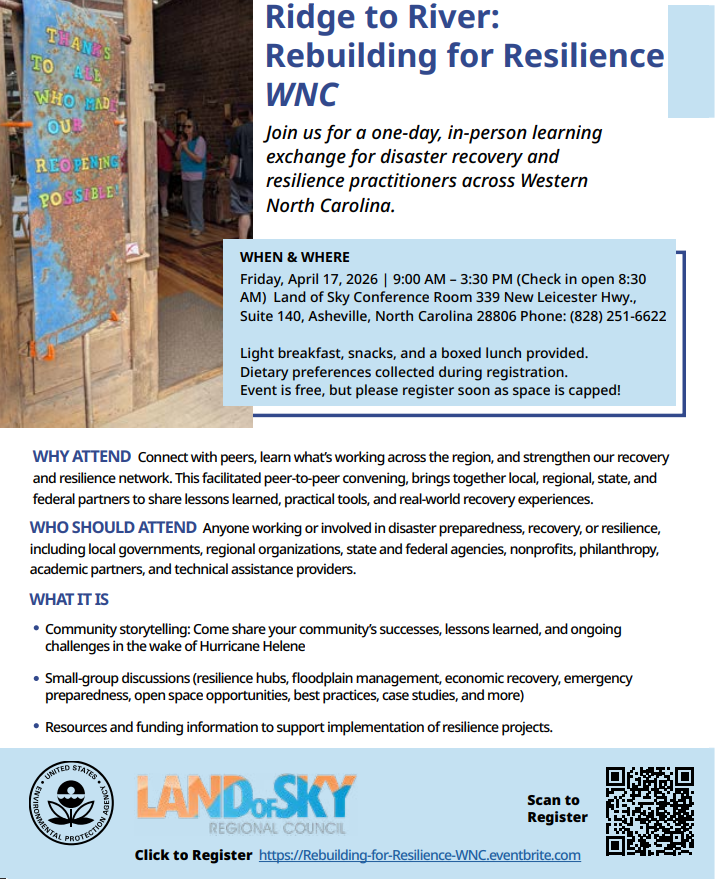
WNC Resilience Convening – April 17, 2026
Join other WNC communities to share successes, lessons learned, and ongoing challenges in the wake of Hurricane Helene. Register now, as space is limited! https://www.eventbrite.com/e/ridge-to-river-rebuilding-for-resilience-wnc-tickets-1980390042929?aff=oddtdtcreator